
Indoor Environment Monitoring System
This project implements a smart IoT-based system designed to monitor and improve indoor environmental conditions. It uses low-cost hardware connected to Azure cloud services to deliver real-time monitoring, automated environmental control, anomaly detection, and temperature forecasting.
Project Overview
- Monitors temperature, humidity, CO, LPG, and smoke in real time.
- Automatically controls a humidity diffuser based on sensor readings.
- Detects abnormal gas levels and issues alerts to the user.
- Generates temperature predictions for the next 24 hours using historical data.
- Integrates hardware, cloud analytics, and dashboard visualizations into a single end-to-end solution.
Hardware Components
- ESP32 microcontroller for data processing and communication
- DHT22 temperature and humidity sensor
- MQ2 gas sensor calibrated for CO, LPG, and smoke detection
- Relay module and diffuser for automated humidity control
- Fully calibrated MQ2 sensor to ensure accurate clean-air reference values
Cloud Architecture
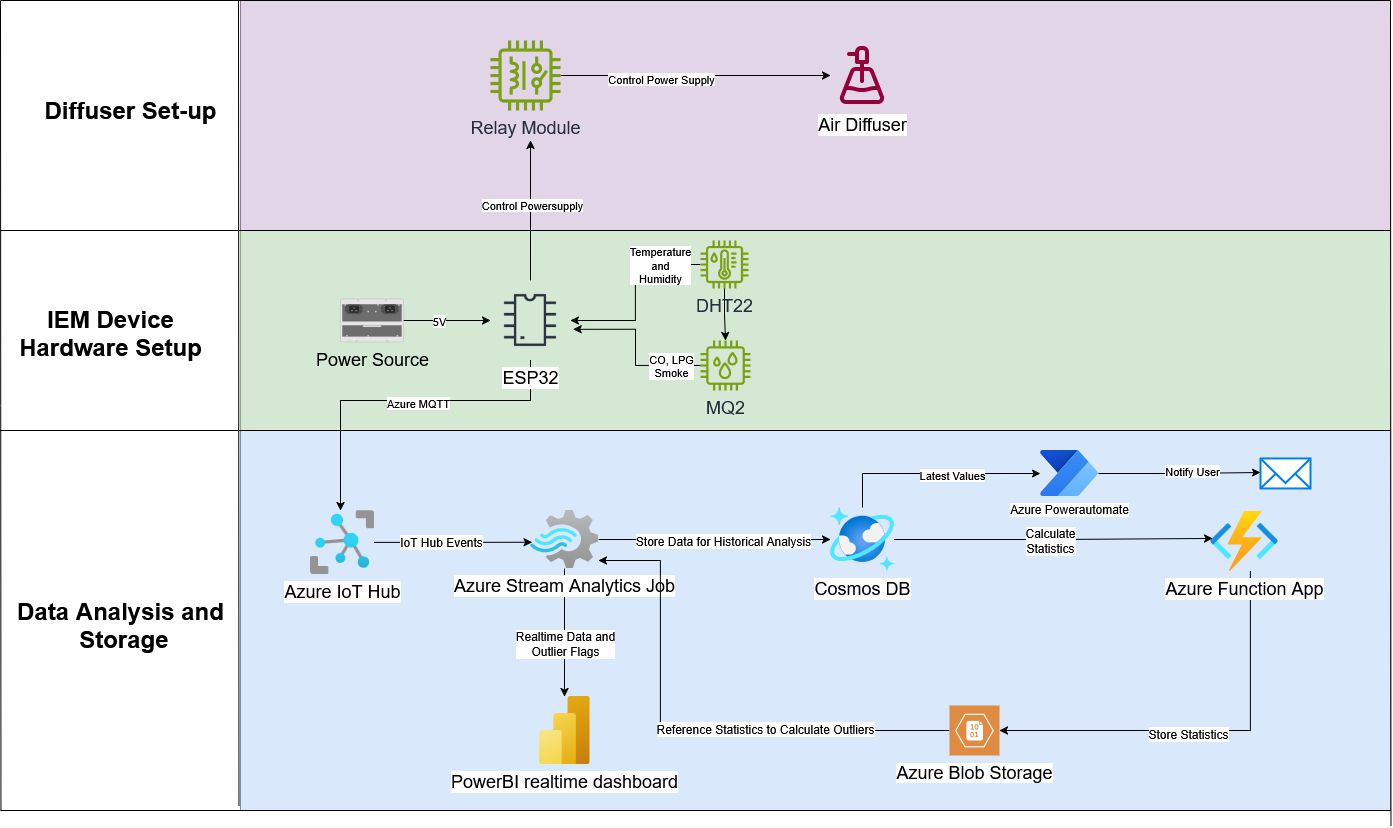
- Azure IoT Hub receives data from the ESP32 device.
-
Azure Stream Analytics processes and routes the telemetry to multiple destinations:
- Power BI for real-time dashboards
- Cosmos DB for historical data storage
- Blob Storage for reference statistics
- Service Bus Queue for automated alert workflows
- Power Automate listens to the queue and sends notifications to the user when high gas levels are detected.
Key Features
Real-Time Monitoring
- Live sensor data for gas, temperature, and humidity.
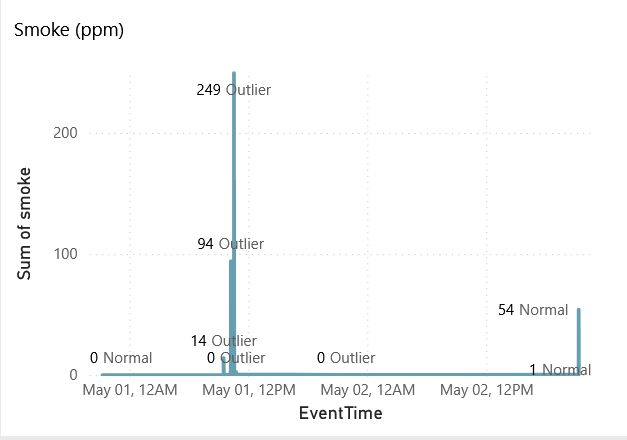
- Power BI dashboard displays up-to-date readings and alerts.
- Alerts appear directly on the dashboard for quick interpretation.
Automated Humidity Control
- ESP32 calculates hourly average humidity.
- If the average drops below 40%, the relay activates the diffuser automatically.
- The diffuser can also be turned off manually through the dashboard.
Gas Leak Detection
- Uses a statistical method based on mean and standard deviation to identify anomalies.
- Detects sudden spikes in CO, LPG, or smoke readings.
- Sends an automated alert through Power Automate and Telegram.
Predictive Analytics
- Azure Function App runs a regression model using historical temperature data stored in Cosmos DB.
- Predicts temperature trends for the next 24 hours.
- Predicted values are stored in Blob Storage and displayed in Power BI.
- The combined view of historical and predicted data helps users anticipate changes in indoor conditions.
Outcome
This project results in a complete IoT-to-cloud pipeline that combines real-time sensing, automated decision-making, historical analysis, and predictive intelligence. Improved real-time safety monitoring in indoor environments through cloud-connected automation.